News
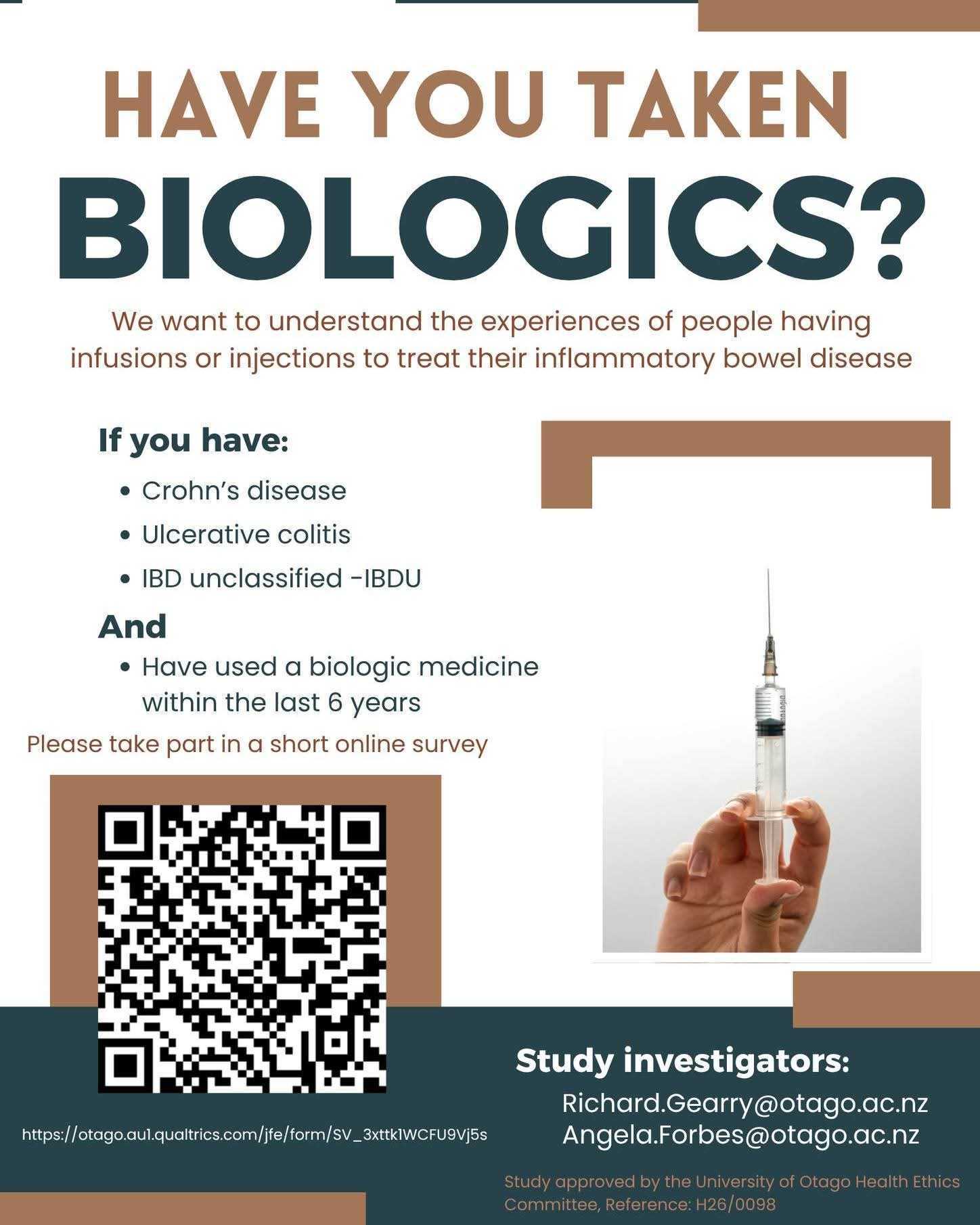
Have You Taken Biologics?
Welcome to this study on the use of biologics for inflammatory bowel disease (IBD).
We are interested in understanding the experiences of patients with IBD who have used infusion or injection biologic medications in the last 6 years. The results of the study may contribute to future proposals for new medications to treat IBD in New Zealand. The study is run through the University of Otago, Department of Medicine, Christchurch. The primary investigator is Professor Richard Gearry and co-investigator Dr Angela Forbes.
This study is for people who have been diagnosed with IBD (Crohn’s disease, ulcerative colitis or inflammatory bowel disease unclassified) who have used one or more, biologic medications since 2020. Examples include: infliximab, adalimumab, vedolizumab, ustekinumab, Remicade, Humira, Amgevita, Entyvio, Stelara. The study should take you around 15 minutes to complete. Participation is voluntary, anonymous, confidential and will not impact your medical care. The study asks about experiences taking biologic medications for IBD, and if the questions raise concerns for you, we encourage you to talk to your GP or contact your IBD nurse. You may withdraw from the study until the final question of the survey has been submitted by contacting Dr Angela Forbes at Angela.Forbes@otago.ac.nz. After the form has been submitted, withdrawal is not possible as responses are anonymous. This study has been approved by the University of Otago Human Ethics Committee (Health), reference H26/0098.

Fasting and Reduced Caloric Intake can Slow Down Tumor Growth in Aged Mice
Researchers from Kumamoto University in Japan investigated whether reducing the caloric intake for mice from 100% to 70% could slow the growth of colorectal tumors. They found that for young mice, there was no suppression of tumor growth in mice fed 70% of their usual dietary requirement. However, in aged mice, there was a marked difference in tumor growth, showing caloric restricted mice had much slower colorectal tumor growth compared to mice fed 100% of their usual dietary calories. They validated their findings in a melanoma model and received the same results, stating the age-dependent tumor suppression was conserved across cancer types.
They also investigated the mechanism by which tumor growth is slowed down. They stated that the mechanism responsible for this protective effect is enhanced infiltration and activation of CD8+ T cells. These cells are specialised for killing cancer cells and were present at higher numbers in tumors of mice subjected to caloric restriction compared to those on a normal diet, they also had increased expression of markers of cell activation and production of effector molecules. As well as T cell infiltration, they found that the tumors of mice subjected to caloric restriction had more normally structured vasculature. Often in tumors blood vessels become leaky and chaotically arranged, which leads to worse malignancy. Their findings showed that caloric restriction could potentially maintain normal tissue structure and keep tumor tissue functional and non-leaky.
Altogether this paper shows some promising results, but it is a study conducted solely in mice. Further investigation into the impact of caloric restriction or fasting is warranted within human cancers and could provide some impactful information about how metabolism interacts with cancer.
Article link: https://www.sciencedirect.com/science/article/pii/S2211124726009228?via%3Dihub